
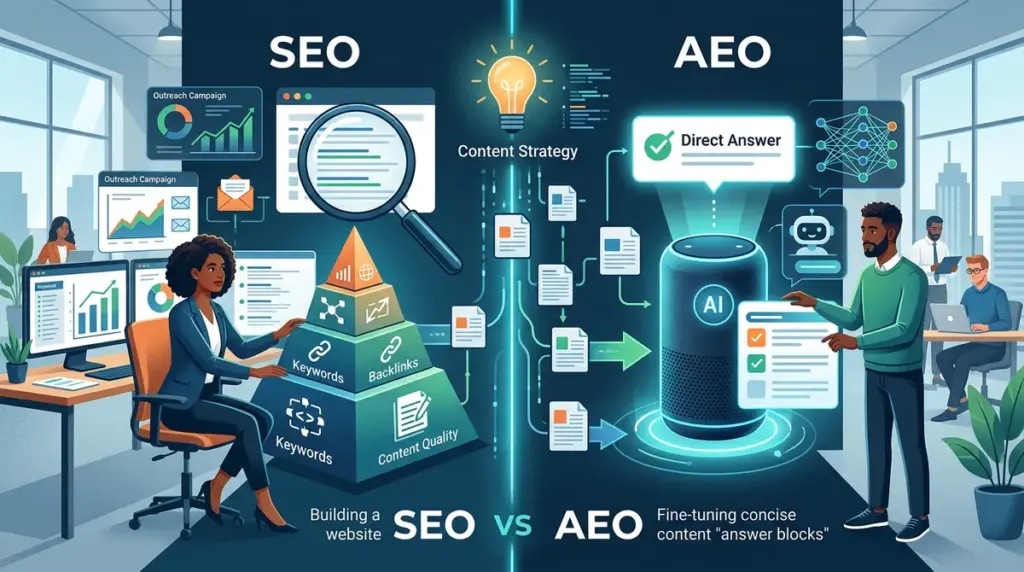
The traditional search funnel is fracturing. For two decades, SEO was a game of winning the click—optimizing meta titles and content structures to drive users from a results page to a website. Today, a growing percentage of search volume ends on the search engine results page (SERP) or within a chat interface. With the rise of Google’s AI Overviews, Perplexity, and ChatGPT, the goal has shifted from being a "link in a list" to being the "source of the answer." This shift is Answer Engine Optimization (AEO). This new landscape requires a different approach, focusing on optimizing content for AI Overviews and the emerging answer engines.
Understanding the distinction between SEO and AEO is no longer a theoretical exercise for digital marketers. It is a tactical necessity. While SEO focuses on visibility and traffic, AEO focuses on authority and synthesis. If your content cannot be parsed, cited, and summarized by an LLM (Large Language Model), you are invisible to a massive segment of modern searchers who prefer immediate synthesis over manual browsing. As search evolves, understanding these distinctions is key to staying visible beyond traditional SERPs.
The Functional Mechanics of AEO vs. SEO
SEO is built on the foundation of crawling and indexing. Search engines like Google use bots to map the web, evaluating pages based on keywords, backlink profiles, and user experience signals to rank them in an order that satisfies a query. The primary metric of success is the Click-Through Rate (CTR).
AEO operates on a different logic: Retrieval-Augmented Generation (RAG). Answer engines do not just point to a source; they ingest information from multiple high-authority sources and generate a cohesive response. To succeed in AEO, your content must be structured in a way that an AI can extract facts with high confidence. It isn’t about being the "best page" on a topic; it is about being the most "reliable fact" for a specific data point.
Best for: Brands in high-intent industries where users seek quick comparisons, definitions, or technical specifications.
Key Differentiators in Strategy
- Intent vs. Fact: SEO targets broad intent (e.g., "best CRM software"). AEO targets specific factual extraction (e.g., "Does Salesforce integrate with Xero natively?").
- Content Structure: SEO relies on long-form, comprehensive guides. AEO prioritizes modular, "snackable" data blocks and structured data (JSON-LD) that define entities and their relationships.
- Success Metrics: SEO measures organic sessions and keyword rankings. AEO measures brand mentions within AI responses and citation frequency in "Sources" panels.
The Technical Architecture of an Answer-Ready Site
To optimize for answer engines, you must move beyond keyword density and focus on entity-based content. LLMs understand the world as a graph of entities (people, places, things, concepts) and the relationships between them. If your site does not explicitly define these relationships, the AI has to guess, which reduces the likelihood of your brand being cited.
Implementing TLSubmit markup is the most direct way to influence AEO. By using specific types like Product, FAQPage, HowTo, and Organization, you provide a machine-readable layer that bypasses the ambiguity of natural language. This reduces the "computational cost" for an AI to verify your information, making it a preferred source for synthesis.
Warning: Avoid "fluff" in your introductory paragraphs. Answer engines prioritize the first 100 words of a section for factual extraction. If your answer is buried under three paragraphs of storytelling, the AI will likely skip your site in favor of a competitor who provides a direct, declarative statement immediately.
Conversational Syntax and Long-Tail Queries
AEO is heavily influenced by voice search and natural language processing. Users interact with answer engines using full sentences: "How do I calculate the ROI of a content marketing campaign?" rather than "content marketing ROI calculator." Your headers (H2s and H3s) should mirror these natural language questions, and the following paragraph should provide a direct, concise answer before expanding into detail. This "inverted pyramid" style of writing is the gold standard for AEO.
Commercial Implications of the Zero-Click Reality
For many stakeholders, the idea of optimizing for a "zero-click" environment sounds counterintuitive. Why spend resources on content that doesn't drive traffic? The answer lies in brand dominance and the "Assisted Conversion."
When an AI engine cites your brand as the definitive source for a complex query, it builds a level of trust that a standard blue link cannot match. In a B2B context, being the cited authority in a ChatGPT or Perplexity response often serves as the first touchpoint in a long sales cycle. If your competitor is the one providing the answers, they are capturing the "mindshare" long before the user ever visits a website. AEO is a defensive play to ensure your brand remains relevant in an ecosystem where the browser is no longer the only gateway to the internet.
Integrating AEO into Your Existing SEO Workflow
AEO does not replace SEO; it augments it. A robust digital strategy requires a bifurcated approach. You still need high-value, long-form content to capture users who want to deep-dive (SEO), but you must also create "Answer Assets" designed specifically for machine consumption (AEO).
Practical Implementation Steps:
- Audit for "Answer Gaps": Identify high-volume questions in your niche that are currently being answered by AI Overviews. If your brand isn't the source, rewrite your content to be more declarative.
- Optimize for "Niche Entities": Focus on specific terminology and jargon that defines your industry. Being the authority on a niche entity makes you a "high-confidence" source for the LLM.
- Improve Site Speed and Readability: While often cited as SEO factors, these are critical for AEO because they affect how efficiently a bot can scrape and process your data during a real-time retrieval phase.
Future-Proofing Your Distribution
As search engines evolve into "everything engines," the winners will be those who provide the cleanest, most authoritative data. This means moving away from vague marketing copy and toward data-backed, structured information. The goal is to become the "knowledge base" for your industry. When an AI looks for a fact, your site should be the easiest and most reliable place for it to find it.
Start by identifying your "Power Pages"—the pages that drive the most commercial value. Add FAQ schemas, simplify the language to be more declarative, and ensure your brand’s unique data is highlighted. This ensures that even if the click never happens, the conversion of influence does.
AEO Implementation FAQ
Does AEO require a different set of tools than SEO?
Not necessarily, but the way you use them changes. You should focus more on "People Also Ask" (PAA) data and conversational keyword research. Tools that track "Share of Model" or AI citations are becoming the new standard for measuring AEO performance, alongside traditional rank tracking.
Will AEO kill organic traffic?
It will likely reduce traffic for "informational" queries (e.g., "What is a mortgage?"). However, it increases the quality of traffic for "investigational" or "transactional" queries. Users who click through from an AI citation are often further down the funnel and more likely to convert because the AI has already done the preliminary filtering for them.
How long does it take to see results from AEO?
AEO can sometimes yield faster results than traditional SEO. Because AI models and search engines are constantly updating their "snapshots" or RAG caches, a well-structured, factual update to a page can result in an AI Overview citation within days, whereas moving from page two to page one in traditional SERPs might take months of backlink building.
Is structured data the only way to win in AEO?
No, but it is the most efficient. LLMs are also trained on high-quality natural language. Clear, logical formatting (using lists, tables, and concise headings) helps the model understand the hierarchy of your information even without explicit schema. However, combining both is the most effective way to ensure your data is correctly interpreted.