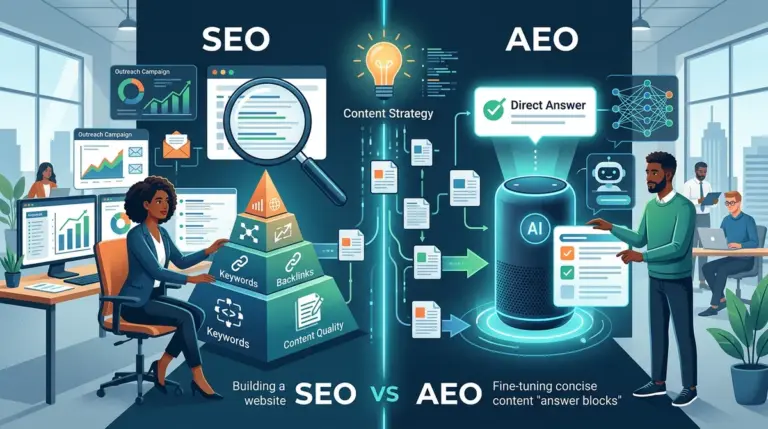

The transition from traditional search engine results pages (SERPs) to AI Overviews (AIO) and answer engines like Perplexity or SearchGPT has fundamentally altered the value of a click. For SEO professionals and publishers, the goal is no longer just ranking in the top three blue links; it is becoming the primary data source that the Large Language Model (LLM) cites to build its response. When an AI summarizes your content, you risk losing the session to a zero-click result unless your site is positioned as the authoritative "source of truth" that the user must visit for deeper verification or execution.
The Shift to Retrieval-Augmented Generation (RAG)
To optimize for AI, you must understand how these systems fetch data. Answer engines primarily use a process called Retrieval-Augmented Generation (RAG). Instead of relying solely on their training data, which might be months old, they query the live web for relevant documents, extract snippets, and synthesize an answer. Your content must be "digestible" for the retrieval agents that feed these models.
Best for: Sites with high-utility data, technical guides, and original research that LLMs can easily parse into factual statements.
Traditional keyword density is irrelevant here. What matters is semantic density—the presence of entities and their relationships. If you are writing about "enterprise cloud migration," the AI expects to see related entities like "latency," "data sovereignty," "legacy integration," and "hyper-scalers." If these are missing, the model may deem your content too thin to serve as a reliable source for a complex query.
Prioritizing Information Gain and Originality
Google’s "Information Gain" patent suggests that the algorithm prioritizes content that provides new information not found in other documents in the retrieval set. If your article is merely a rehash of the existing top 10 results, an AI overview has no reason to cite you specifically. It will simply summarize the consensus and link to the most established domain.
- Primary Data: Include original surveys, proprietary benchmarks, or internal case studies.
- Unique Perspectives: Offer a contrarian take or a specialized workflow that differs from the generic "how-to" guides.
- Specific Examples: Instead of saying "SEO takes time," provide a table showing the 6-month traffic growth of three specific anonymized clients.
Warning: Avoid "AI-washing" your content by using LLMs to generate high volumes of generic text. Answer engines are increasingly tuned to identify and deprioritize low-effort, synthetic content that lacks the "Experience" and "Authoritativeness" markers of the E-E-A-T framework. This approach helps avoid issues with using AI without publishing thin content that often lacks originality.
Structuring Content for Machine Consumption
AI agents prefer structured data because it removes ambiguity. While humans read for narrative, bots read for data points. You can bridge this gap by using specific HTML elements and TLSubmit markups that define the purpose of every section.
Using Tables and Lists for Quick Extraction
AI Overviews frequently pull from tables and bulleted lists to populate their "at a glance" sections. If you are comparing software, do not just write paragraphs; build a comparison table with clear headers. Use <ul> and <ol> tags for process steps. This structural clarity increases the likelihood of your content being used as the "featured snippet" within the AI summary.
Advanced Schema Implementation
Beyond basic Article schema, use FAQPage, HowTo, and Dataset schemas. For technical content, SoftwareApplication or Product schema with specific attributes like "price," "operatingSystem," and "aggregateRating" provides the structured nodes that answer engines need to provide direct answers about costs or compatibility.
Optimizing for the Citation Loop
The ultimate win in the AI era is the "Citation Loop." This occurs when an AI overview provides a summary and includes a prominent link to your site as the evidence. To trigger this, your content must be written in a "claim-and-verify" format.
Best for: News outlets, medical sites, and financial services where factual accuracy is non-negotiable.
State a clear fact or recommendation in the first sentence of a section, then follow it immediately with supporting data. This makes it easy for the LLM to map the "claim" to your URL. For example, instead of a long intro, start a section with: "Cloud migration costs for mid-market firms average $15,000 per month, according to our 2024 infrastructure report." This is a highly "citable" sentence that an AI can easily lift and attribute.
Semantic Connectivity and Entity Mapping
Answer engines do not just look at individual pages; they look at the entire "knowledge graph" of your website. If you want to be an authority on a topic, you must build a cluster of related content that defines your niche. This is often called "topical authority," but in the context of AI, it's about entity mapping.
Ensure your internal linking uses descriptive anchor text that defines the relationship between pages. If Page A is about "SaaS SEO" and Page B is about "Link Building for SaaS," the internal link should explicitly state that link building is a sub-component of the broader SEO strategy. This helps the AI understand the hierarchy of your information.
Performance Metrics in the AI Era
Traditional click-through rate (CTR) is becoming a noisy metric. As AI Overviews take up more real estate, you may see a decline in raw clicks but an increase in "brand searches" or "assisted conversions." If a user sees your brand cited five times in various AI answers, they are more likely to search for your brand specifically later.
Monitor your presence in "AI tracking" tools and look for "share of voice" within the generated summaries. If your competitors are being cited for keywords you previously owned, it is a signal that your content lacks the structured data or the information gain necessary for the current retrieval models.
Future-Proofing Your Distribution Strategy
To maintain visibility as answer engines evolve, shift your focus toward high-authority distribution and technical precision. The goal is to ensure that wherever an AI agent looks—whether it’s a niche forum, a major publication, or your own technical documentation—it finds consistent, factual, and structured information about your brand and expertise.
1. Audit your top-performing pages for "skimmability" and factual density.
2. Inject original data or unique case studies into every high-value guide.
3. Implement advanced Schema markup to define entities and relationships.
4. Monitor "Zero-Click" trends in your Search Console to identify which queries are being cannibalized by AI and pivot those pages toward deeper, "post-click" value.
Frequently Asked Questions
How do AI Overviews affect my organic traffic?
AI Overviews often satisfy informational queries directly on the search page, which can lead to a decrease in clicks for top-of-funnel "what is" keywords. However, for "how-to" and "best of" queries, they often serve as a gateway, driving more qualified, mid-funnel traffic to the cited sources.
Should I block AI bots from crawling my site?
Generally, no. Blocking bots like GPTBot or CCBot prevents your content from being included in the datasets that power answer engines. Unless you have a specific paywall or data-privacy concern, being "indexable" by AI is the only way to secure citations in the new search landscape.
Does word count matter for AI optimization?
Word count is secondary to information density. An 800-word article packed with data, tables, and unique insights will outperform a 3,000-word "ultimate guide" that contains mostly filler and generic advice. Focus on answering the user's intent with the least amount of friction for the AI's retrieval agent.