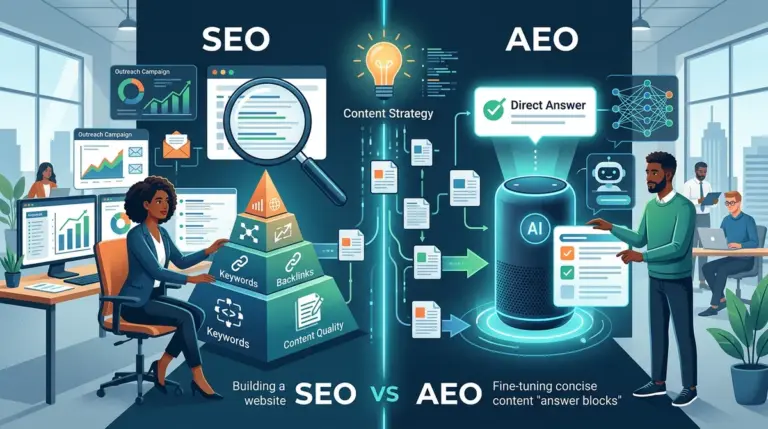
The traditional search engine results page (SERP) is no longer the sole gatekeeper of organic traffic. With the rise of SearchGPT, Perplexity, and Google’s AI Overviews, the objective has shifted from ranking in the top three blue links to becoming a cited source within a generative response. This shift, often called Generative Engine Optimization (GEO), requires a fundamental pivot in how we approach content distribution and technical SEO. If your brand is not part of the Large Language Model’s (LLM) training data or its real-time retrieval window, you are effectively invisible to a growing segment of users who bypass traditional search results entirely. This new landscape requires a dedicated strategy for optimizing for AI Overviews and Answer Engines to ensure your content is discoverable.
Shifting from Keyword Density to Entity-Based Authority
LLMs do not process content as a string of keywords; they process it as a network of entities and relationships. To stay visible, your site must establish itself as a definitive authority on specific topics. This means moving away from shallow, high-volume keyword targeting and toward deep, interconnected content clusters that define your brand as an "Entity" within the Knowledge Graph. Focusing on building topical authority is key to avoiding thin, repetitive content that LLMs are less likely to surface.
Best for: Established brands looking to defend their market share against AI-summarized competitors.
AI search engines prioritize sources that demonstrate clear expertise, authoritativeness, and trustworthiness (E-E-A-T). When an AI engine like Perplexity synthesizes an answer, it looks for consensus across multiple high-authority domains. If your site is the only one making a claim, it is likely to be ignored. If your data is cited across niche directories, industry publications, and news outlets, the AI recognizes that data as a factual "truth," increasing the likelihood of a citation.
The Mechanics of Citation Optimization
Visibility in AI search is directly proportional to your citation footprint. Unlike traditional SEO, where a backlink primarily passes PageRank, a citation in the AI era provides the model with a verifiable reference point. To maximize these occurrences, your distribution strategy must prioritize high-signal platforms.
- Niche Aggregators and Directories: AI models frequently scrape structured data from industry-specific hubs to verify business details and service offerings.
- Press Release Distribution: Direct distribution of factual, data-heavy news ensures that your brand’s latest developments are indexed in real-time retrieval windows.
- Technical Documentation: LLMs favor content structured in logical hierarchies, such as tables, lists, and clear step-by-step guides.
By using a distribution service to seed your content across a variety of authoritative domains, you create the "consensus" that AI models look for when validating information. This is not about bulk link building; it is about strategic footprint expansion.
Technical Requirements for Semantic Visibility
If an AI bot cannot easily parse your data, it will not use it. While traditional search engines have become adept at reading messy HTML, generative engines prefer highly structured environments. Implementing advanced Schema markup is no longer optional; it is the primary language of AI search.
Advanced Schema Implementation
Standard Organization and Article schema are the baseline. To stand out, you must use about and mentions properties within your JSON-LD to explicitly link your content to established entities in Wikidata or DBpedia. This tells the AI exactly which concepts your content covers, removing the guesswork from its natural language processing (NLP) layers.
Optimizing for Retrieval-Augmented Generation (RAG)
Most modern AI search tools use RAG to pull fresh information from the web. These systems look for "chunks" of text that directly answer a query. To optimize for this, use the "Inverted Pyramid" style of writing: place the most critical information—the direct answer—in the first paragraph, followed by supporting data and context. Use clear, declarative sentences. Avoid flowery metaphors that can confuse a model's semantic understanding.
Warning: Avoid "AI-baiting" with hidden text or keyword stuffing in metadata. Modern LLMs are trained to detect patterns of low-value content. Over-optimization that degrades human readability will eventually lead to your domain being filtered out of the retrieval set entirely.
Content Formatting for LLM Extraction
AI models are designed to summarize. You can influence the quality of that summary by providing "summary-ready" content blocks. This involves using specific HTML elements that signal importance to a crawler.
Best for: Publishers and B2B SaaS companies who want their features or data points highlighted in AI comparisons.
Use <table> tags for data comparisons and <ol> or <ul> for process steps. AI engines are significantly more likely to pull a table directly into a generative response than to parse the same data from a long-form paragraph. Additionally, ensure your site's robots.txt allows access to the specific user agents used by AI crawlers, such as GPTBot or OAI-SearchBot, unless you have a specific strategic reason to block them.
Future-Proofing Your Distribution Strategy
The transition from SERPs to AI interfaces means that "off-page SEO" is now "off-page brand presence." You cannot rely on your website alone to tell the story. You need a multi-channel distribution approach that places your brand in the path of the AI’s training and retrieval loops.
Focus on getting mentioned in independent reviews, industry whitepapers, and high-authority news sites. These third-party mentions act as third-party validation for the AI. When SearchGPT sees your brand mentioned as a "top solution" across five different high-authority domains, it gains the "confidence" required to recommend you to a user. This is where strategic content distribution becomes your most effective SEO lever.
Actionable Steps for Immediate AI Visibility
To move beyond traditional rankings and secure a spot in generative responses, execute the following workflow:
1. Audit your Entity Presence: Search for your brand in Perplexity or Gemini. Note which sources it cites. If it cites competitors, analyze their backlink profile and distribution strategy.
2. Implement Speakable Schema: Use Speakable schema to identify sections of your page that are best suited for audio or concise AI summaries.
3. Aggressive Content Distribution: Use a service to push data-backed articles and press releases to authoritative outlets. This builds the necessary "web of mentions" that AI models use to verify facts.
4. Refactor Top-Performing Content: Identify your top 10 traffic-driving pages and rewrite the introductions to include a 2-3 sentence "TL;DR" that an AI can easily scrape and attribute to you.
Frequently Asked Questions
How does AI search differ from traditional Google search?
Traditional search provides a list of sources for the user to evaluate. AI search synthesizes those sources into a single answer, often providing citations. The goal shifts from earning a click to becoming the "source of truth" within the answer.
Will traditional SEO tactics still work?
Yes, but they are no longer sufficient. High-quality backlinks and technical health are still baseline requirements, but you must now add entity-based optimization and structured data to ensure AI models can interpret your content correctly.
Does blocking AI bots help or hurt SEO?
For most commercial sites, blocking AI bots like GPTBot will hurt visibility. If the bot cannot crawl your site, the AI cannot cite you as a source, effectively handing that traffic and brand authority to your competitors who do allow crawling.
How do I track my performance in AI search?
Traditional rank tracking is less effective here. Instead, monitor "Share of Model" by querying LLMs for your primary keywords and tracking how often your brand is cited compared to competitors. Tools are emerging to automate this, but manual auditing of major models is currently the most accurate method.