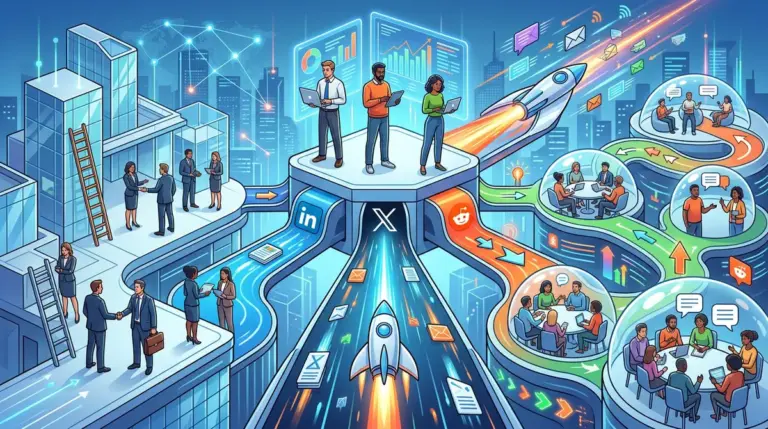
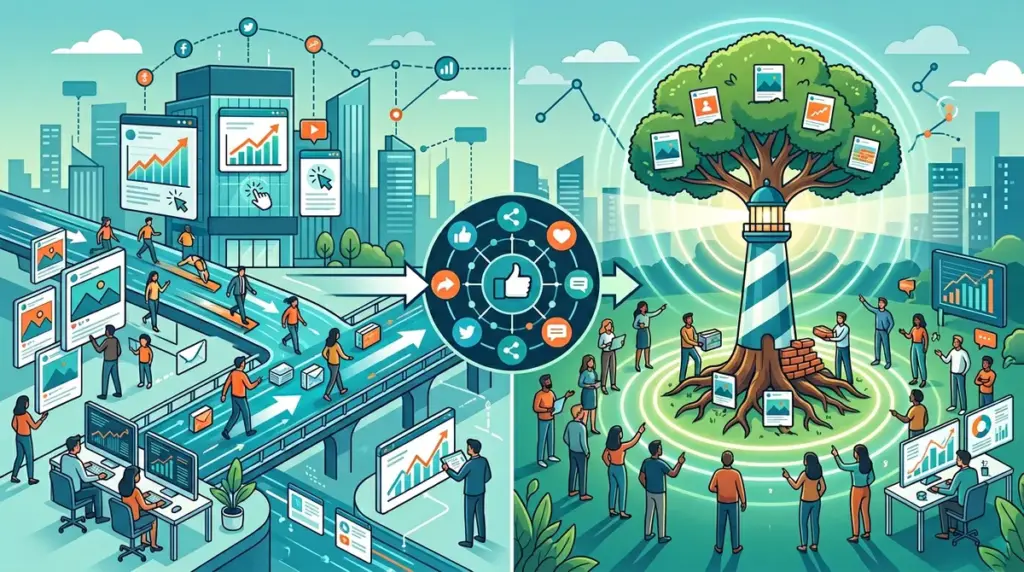
Marketing teams often conflate social media reach with business growth, but the mechanics of driving website traffic are fundamentally at odds with the mechanics of building a brand. Social platforms operate as "walled gardens." Their algorithms are engineered to keep users on-site, meaning every outbound link you post carries a hidden "reach tax." If your goal is to move a user from a LinkedIn feed to a high-intent landing page, you are fighting the platform's core architecture. Conversely, if your goal is brand awareness, you must optimize for native consumption, which often results in zero immediate referral traffic. If your goal is brand awareness, you must optimize for native consumption, which often results in zero external clicks, unlike strategies focused on driving traffic. Short-form video content can be a great way to achieve this optimizing for native consumption.
Understanding this trade-off is the difference between a high-ROI distribution strategy and a wasted content calendar. You cannot maximize both metrics simultaneously with the same post. A sharp social strategy requires a bifurcated approach: one track designed to extract users for conversion, and another designed to occupy mental real estate within the feed itself.
The Algorithmic Tax on Outbound Links
Most platforms, specifically X (formerly Twitter), LinkedIn, and Facebook, prioritize "native content." When an algorithm detects an external URL, it typically de-prioritizes that post in the feed because it threatens the platform's ad revenue by encouraging the user to leave. This is why a text-only post or a native video often receives 5x to 10x the impressions of a link-heavy post.
Best for Traffic: Direct response campaigns, whitepaper downloads, and time-sensitive promotions. Here, you accept lower reach in exchange for high-intent clicks.
Best for Brand: Thought leadership, industry commentary, and educational carousels. Here, you sacrifice the click to ensure the maximum number of people see and digest your expertise without leaving their feed.
Architecture of a Traffic-Driven Campaign
Traffic-focused social media is essentially a distribution play. You are using the platform as a gateway, not a destination. For SEO professionals and publishers, this is the primary method for accelerating the "indexation-to-authority" pipeline by forcing real human signals to a new URL.
- The "Link in Comments" Workaround: To bypass reach suppression, many marketers post a high-value native image or text block and place the destination URL in the first comment. This signals to the algorithm that the post is "engagement-focused" while still providing a path to the site.
- Direct Response Copywriting: Traffic posts must use "open loops." You provide enough information to create curiosity but leave the "payoff" on the destination page.
- UTM Tagging: Without granular UTM parameters, traffic-driven social is impossible to measure. You must distinguish between organic social clicks and "dark social" (links shared in private DMs or Slack) to understand which platforms actually convert.
Pro Tip: If you are running a traffic campaign on LinkedIn, use "Document Posts" (PDF uploads). You can include a call-to-action on the final slide. These currently receive the highest organic reach while still allowing you to drive users toward a specific URL via the post description.
Architecture of a Brand-Driven Campaign
Brand-focused social media is about "Zero-Click Content." The goal is to provide so much value within the post itself that the user feels they have learned something without ever clicking a link. This builds authority and trust, which shortens the sales cycle later when the user eventually searches for your brand name directly in Google.
In a brand-first model, the KPI is not Click-Through Rate (CTR), but "Share of Voice" and "Save Rate." When a user saves a post, they are signaling to the algorithm that the content is a high-value resource. This increases your future reach, making your occasional traffic-focused posts more effective because you have built a larger "base" of followers who see your content.
Key Differentiators in Execution
The following table outlines the tactical shifts required when moving between these two objectives:
Traffic Focus:
Primary Metric: CTR and Landing Page Conversion.
Content Type: Teasers, snippets, and "Click to read more" hooks.
Frequency: High. You need volume to overcome algorithmic suppression.
Visuals: High-contrast thumbnails designed to stop the scroll.
Brand Focus:
Primary Metric: Comments, Shares, and Direct Mentions.
Content Type: Full-length essays, native video, and complete infographics.
Frequency: Medium. Quality and depth matter more than daily output.
Visuals: Consistent brand aesthetic and typography that builds recognition.
The Hybrid Distribution Model
The most sophisticated SEO and marketing teams use a 80/20 split. Eighty percent of the output is brand-focused, designed to game the algorithm for maximum reach and build an audience. The remaining twenty percent is traffic-focused, "cashing in" that built-up reach to drive users to a high-value asset, such as a new tool, a deep-dive report, or a product page.
This hybrid approach solves the "reach decay" problem. If you only post links, your reach will eventually bottom out as the algorithm flags your account as a "low-value outbound poster." By mixing in high-engagement native content, you keep your account healthy in the eyes of the platform's AI, ensuring that when you do post a link, it actually reaches people.
Building Your Social Distribution Roadmap
To stop wasting resources on social media, you must audit your current output and categorize every post as either "Extraction" (Traffic) or "Contribution" (Brand). If a post tries to do both, it will likely fail at both. Follow these steps to refine your workflow:
1. Identify your high-intent URLs. These are the pages that actually generate revenue or leads. These get "Traffic" posts with clear, aggressive calls to action.
2. Identify your core expertise. These are the topics you want to be known for in your industry. These get "Brand" posts that are entirely native to the platform, with no outbound links.
3. Monitor your "Direct" traffic in Google Analytics. A successful brand strategy on social media often manifests as an increase in direct traffic and branded search queries, rather than referral traffic from the social platforms themselves.
4. Use social signals for SEO. While social links are generally "no-follow," the surge in traffic and engagement from a well-timed traffic post can trigger faster crawling and signal relevance to search engines, especially if the traffic leads to high dwell times on your site.
Frequently Asked Questions
Does social media traffic help my SEO rankings?
Social signals are not a direct ranking factor, but the secondary effects are significant. High traffic from social media leads to increased brand searches, potential backlink opportunities from people who discovered your content, and faster indexation of new pages.
Why is my reach so low when I post links to my blog?
Platforms like LinkedIn and Facebook actively suppress posts with outbound links to keep users on their site. To fix this, try the "link in comments" method or focus on creating a native summary of the blog post that provides value without requiring a click.
How do I measure the ROI of brand-focused social media?
Look at "Branded Search Volume" in Search Console. If your brand-focused social strategy is working, more people will search for your company name directly. You should also track "Assisted Conversions" in your analytics to see if users touched your social profiles before eventually converting through another channel.