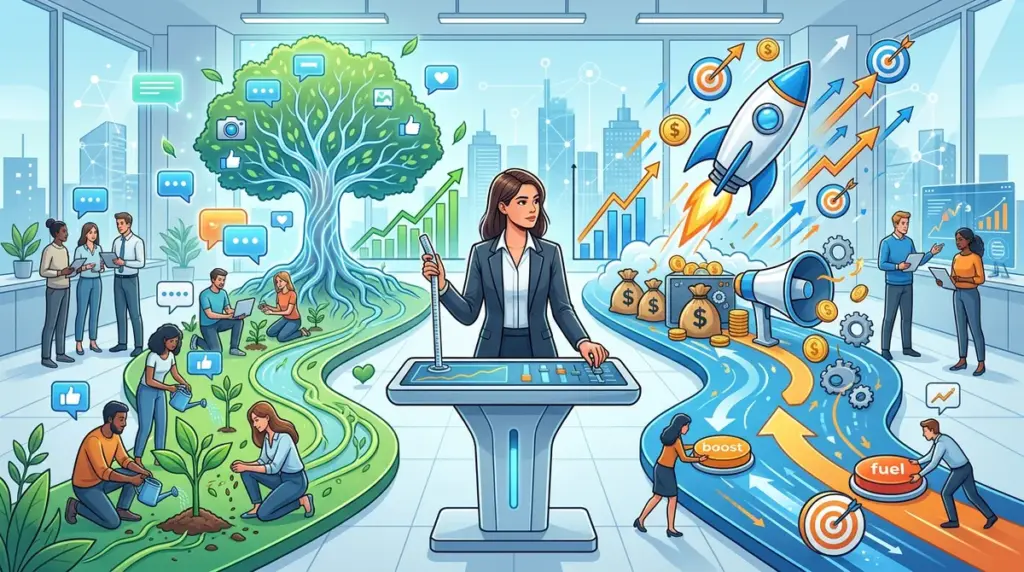
The choice between organic and paid social media is rarely an either-or proposition, but the allocation of resources depends entirely on your current business stage and immediate objectives. Organic social functions as a digital storefront and a customer retention engine. Paid social acts as a high-velocity distribution channel designed to bypass algorithm limitations and reach specific, cold audiences. For SEO professionals and site owners, the distinction is critical: organic builds the brand authority that improves search click-through rates, while paid social drives the immediate traffic spikes that organic reach can no longer guarantee.
The Structural Role of Organic Social
Organic social media encompasses any content posted without a dedicated advertising spend. Its primary value lies in community management, brand storytelling, and establishing a searchable history of expertise. While platform algorithms have significantly throttled organic reach—often limiting it to less than 5% of a brand's total followers—it remains the prerequisite for trust.
Best for: Customer service, brand personality, nurturing existing leads, and building a library of social proof.
When a potential client discovers your site through a search engine, they frequently cross-reference your social profiles to verify your activity level and reputation. A dormant organic presence suggests a dormant business. Organic content allows you to experiment with messaging and voice without the financial risk of a failed ad campaign. It is also the primary vehicle for distribution of long-form SEO content, providing the initial "seed" traffic that can signal relevance to search engines.
The Retention and Feedback Loop
Organic channels serve as a direct line to your most loyal users. This is where you handle public inquiries, manage reputation, and gather qualitative data. Unlike paid ads, which are transactional, organic posts facilitate a dialogue. This feedback loop is essential for refining product descriptions, identifying common pain points for future blog posts, and understanding the vocabulary your audience uses—which directly informs your keyword research strategy.
The Mechanics of Paid Social
Paid social media is a precision tool for scale. It allows you to target users based on granular data points—job titles, interests, purchasing behavior, and geographic location—that organic posts cannot reach. In an era where "pay-to-play" is the standard for platforms like Meta and LinkedIn, paid social is the only way to guarantee visibility for time-sensitive offers or high-value lead magnets.
Best for: Lead generation, retargeting, rapid testing, and breaking into new market segments.
The primary advantage of paid social is the ability to bypass the "follower" barrier. You are not limited to the people who already know your brand. You can use lookalike audiences to find users who share characteristics with your highest-value customers, or use retargeting pixels to stay top-of-mind for users who visited your site but didn't convert. This creates a highly efficient conversion funnel that complements long-term SEO efforts by capturing intent in real-time.
Warning: Never scale a paid social campaign based on "vanity metrics" like likes or shares. If the cost per acquisition (CPA) exceeds the lifetime value of the customer, the campaign is failing, regardless of how much engagement the creative generates. Always tie ad spend to a specific conversion event, such as a newsletter sign-up or a product purchase.
Direct Response vs. Awareness Campaigns
Paid social is typically divided into two categories: top-of-funnel (TOFU) awareness and bottom-of-funnel (BOFU) direct response. Awareness campaigns are designed to introduce your brand to a broad audience at a low cost-per-thousand-impressions (CPM). Direct response campaigns, however, focus on a specific action. For agencies and B2B publishers, direct response ads on LinkedIn are often the most effective way to distribute white papers or case studies to decision-makers who are unlikely to find them through organic search alone.
Strategic Integration: The Hybrid Approach
The most effective marketing workflows use organic social as a testing ground for paid campaigns. By monitoring which organic posts receive the highest engagement rates or click-throughs, you can identify "proven" creative concepts before putting a budget behind them. This reduces the risk of ad fatigue and wasted spend.
- Promote High-Performing Organic Content: If a specific post is gaining traction naturally, "boost" it to a wider audience to capitalize on existing momentum.
- Retarget Organic Visitors: Use paid ads to reach people who have engaged with your organic content but haven't yet visited your website.
- Use Paid to Support SEO: When launching a new, high-competition keyword page, use paid social to drive immediate traffic. This can help search engines index the page faster and gather initial user behavior data.
- Maintain a Consistent Aesthetic: Ensure that your paid ads look and feel like your organic content. Disjointed branding creates friction and lowers conversion rates.
Allocating Budget and Resources
Resource allocation should follow your business's maturity. Early-stage sites should lean more heavily on organic social to define their voice and paid social to find their first customers. Mature brands often use organic social for "defense"—maintaining reputation and community—while using paid social for "offense"—capturing market share from competitors.
For SEO-driven businesses, the "organic-first" mentality is often a trap. While organic social is "free" in terms of ad spend, it is expensive in terms of labor and time. Paid social offers a shortcut to data. If you need to know if a specific value proposition resonates with a target demographic, a $500 ad test will give you a definitive answer in 48 hours, whereas organic testing might take months to reach a statistically significant audience.
Executing a Cross-Channel Social Strategy
To maximize the ROI of both channels, treat them as a single ecosystem. Use organic social to build the "who" and "why" of your brand, and use paid social to handle the "where" and "when" of the transaction. Start by auditing your current social performance. If your organic reach is declining, do not simply post more often; instead, shift that labor time into creating one high-quality piece of content and using a small paid budget to ensure it reaches the right eyes. This approach can also help you repurpose your blog content for social media, creating a richer content ecosystem.
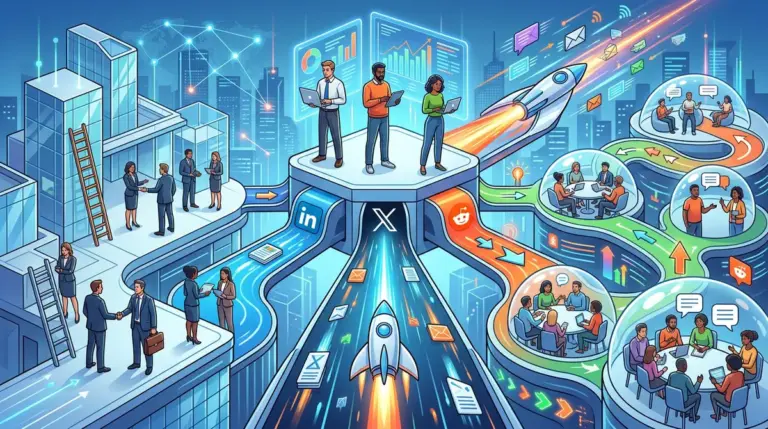
Focus your organic efforts on platforms where your community is most active (e.g., X for real-time tech updates or LinkedIn for professional networking). Focus your paid efforts on platforms with the most robust targeting tools. By syncing these efforts, you create a self-sustaining loop where organic builds the trust that makes paid ads more effective, and paid ads drive the new followers that keep your organic community growing.
Social Strategy FAQ
Does organic social media impact my SEO rankings?
Social signals are not a direct ranking factor for Google. However, organic social drives traffic, increases brand searches, and encourages natural backlink acquisition. These secondary effects are highly beneficial for SEO and help establish the "Authority" and "Trust" components of E-E-A-T.
How much should I spend on paid social before seeing results?
There is no universal minimum, but you need enough spend to exit the "learning phase" of most ad platforms (usually around 50 conversion events). For most small to mid-sized B2B campaigns, a starting budget of $1,000 to $2,000 per month is necessary to gather actionable data and see a measurable return on investment.
Should I post the same content on organic and paid channels?
Not exactly. While the core message should be consistent, paid ads require a clearer call-to-action (CTA) and often benefit from more polished, conversion-oriented design. Organic content should feel more native to the platform and focus on providing value or starting a conversation rather than asking for a sale.
Which platform is best for B2B paid social?
LinkedIn remains the gold standard for B2B due to its professional targeting capabilities, such as job title and company size. However, Meta (Facebook/Instagram) can often deliver a lower cost-per-lead (CPL) for B2B if you use robust retargeting or lookalike audiences based on your existing customer list.