
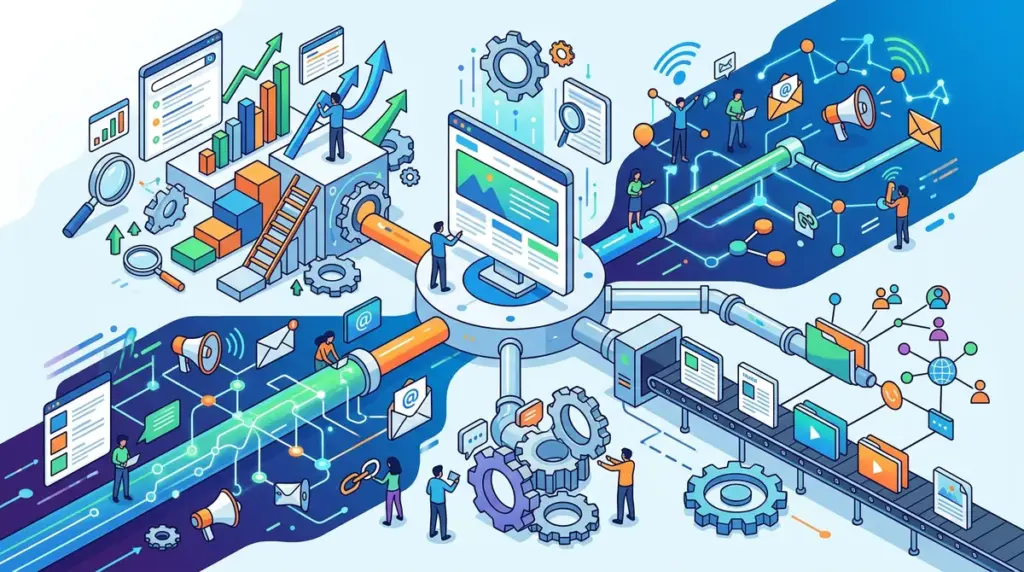
Launching a new website creates an immediate "cold start" problem. You have no domain authority, no historical data for the Google algorithm to trust, and zero organic visibility. The instinct for many founders is to "be everywhere," but spreading a limited budget across ten channels ensures none of them reach the critical mass required to generate a lead. The goal for a new site is not broad awareness; it is the rapid acquisition of data and the establishment of initial trust signals.
For a new domain, marketing channels must be evaluated based on their "Time to Value" (TTV). SEO takes months to mature, while PPC can deliver traffic in minutes. A balanced strategy uses high-velocity channels to validate the product and messaging while simultaneously building the long-term infrastructure of organic search and referral networks. The following channels are selected for their ability to break through the initial obscurity of a new domain. Understanding the core concepts of what digital marketing is becomes paramount for any new venture.
Prioritizing Channels for Initial Traction
Before selecting a channel, you must identify your site’s primary bottleneck. If your site is technically sound but lacks authority, your focus should be on external citations and backlink-heavy channels. If your site has content but no users, you need high-intent paid traffic. Consider these three factors:
Intent vs. Discovery: Are users actively searching for your solution (Search), or do they need to be interrupted while browsing (Social)? New sites usually find faster ROI in high-intent channels where the user is already looking for a fix.
Feedback Loops: New websites often have unoptimized conversion paths. Channels like Google Ads provide immediate feedback on whether your landing page actually works. Organic SEO provides feedback too slowly for initial site optimization.
Compounding Equity: Some channels are "rented" (Paid Ads), and some are "owned" (SEO, Email). A new site must invest in owned channels early to avoid becoming permanently dependent on rising ad costs.
1. Google Organic Search
Google Organic Search remains the primary source of sustainable, high-intent traffic. For a new website, the strategy is not to compete for high-volume head terms like "marketing software," but to dominate the "long-tail"—highly specific, four-to-seven-word queries with low competition. This requires a "bottom-up" content strategy. By answering hyper-specific questions that established competitors ignore, a new site can start indexing and earning clicks within weeks rather than years. This builds the initial "topic authority" that eventually allows the site to rank for more competitive terms.
Best for: Building long-term, zero-cost acquisition and establishing industry authority through educational content.
Pros: Traffic quality is exceptionally high because users are actively seeking information; creates a compounding asset that delivers value long after the content is published.
Cons: Significant delay in results, often taking 3 to 6 months to see meaningful movement; requires consistent technical maintenance and high-quality content production.
Verdict: Non-negotiable for any site intended to last more than a year. Start by targeting "zero volume" keywords that your specific customers are asking about in sales calls.
2. Google Search Ads
Google Ads (PPC) is the fastest way to bypass the "sandbox" period of a new website. It allows you to buy your way to the top of the search results for the exact keywords you eventually want to rank for organically. For a new site, the primary value of PPC isn't just sales—it's data. You can see which keywords lead to conversions and which have high bounce rates. This data informs your SEO strategy, ensuring you don't spend months trying to rank for a keyword that doesn't actually sell your product.
Best for: Immediate traffic, testing landing page conversion rates, and identifying high-value keywords for SEO focus.
Pros: Instant visibility; granular control over who sees your site based on geography, device, and intent; easy to scale up or down based on performance.
Cons: Extremely expensive in competitive niches; traffic stops the moment you stop paying; requires constant monitoring to avoid "budget bleed" on irrelevant queries.
Verdict: Use this as a laboratory. Spend enough to get 1,000 clicks to your main landing pages to see if your site actually converts before you invest heavily in other areas.
3. Niche Directory Submissions
New websites are often viewed as "untrusted" by search engines. Niche directories—platforms specifically curated for a single industry or service type—act as foundational trust signals. These are not the "link farms" of the past, but legitimate industry hubs. Getting listed on a reputable niche directory provides two benefits: a relevant backlink that aids indexation and a direct source of referral traffic from users who are already deep in the consideration phase of the buyer's journey.
Best for: Building initial domain authority and securing referral traffic from high-intent industry hubs.
Pros: Provides high-relevance backlinks that are difficult to get through standard outreach; often results in higher conversion rates than general social media traffic.
Cons: High-quality directories often require a one-time or annual listing fee; low-quality directories can potentially harm your site's reputation if not vetted.
Verdict: Essential for the first 30 days of a site launch. Focus on the top 10-15 most respected directories in your specific vertical rather than a mass-submission approach.
4. LinkedIn Organic Content
For B2B websites, LinkedIn is the most effective channel for reaching decision-makers without a massive ad spend. The platform’s current algorithm still favors organic reach for individual profiles more than company pages. By having founders or key employees share insights, case studies, or "build-in-public" updates, a new website can drive high-value professional traffic. This channel relies on "social proof"—when people see a human face behind the new site, the barrier to clicking through is significantly lowered.
Best for: B2B lead generation, networking with industry influencers, and establishing founder authority.
Pros: High concentration of professional decision-makers; excellent organic reach compared to Facebook or Instagram; allows for direct engagement with potential clients.
Cons: Requires a significant time investment from senior leadership; content has a very short shelf life (usually 24-48 hours).
Verdict: Best utilized by founders who can commit to posting three times a week. Use it to drive traffic to "lead magnet" content on your new site to build an email list.
5. Meta Paid Social
Facebook and Instagram ads are the gold standard for "interruption marketing." If your website sells a visual product or a solution to a problem people don't know they have yet, Meta’s targeting engine is peerless. For a new site, Meta Ads are particularly useful for "retargeting." If a user visits your site via a Google Search but doesn't buy, you can use Meta Ads to follow them and stay top-of-mind. This creates the illusion that your new brand is "everywhere," which builds the trust necessary for a first-time purchase.
Best for: B2C products, visual branding, and retargeting visitors who didn't convert on their first visit.
Pros: Sophisticated visual targeting; lower Cost-Per-Click (CPC) than Google Ads in many industries; powerful lookalike audience features.
Cons: Users are not in a "buying" mindset when browsing; requires high-quality creative (video/images) which can be expensive to produce.
Verdict: Start with a small "Retargeting" budget. It is much cheaper to bring back a lost visitor than to find a new one, making it highly efficient for new domains with low traffic.
6. X (Twitter) Networking
While X has become more volatile, it remains the fastest channel for real-time networking and "building in public." For a new website, especially in tech, SaaS, or media, X allows you to interact directly with journalists, influencers, and early adopters. The key here isn't just posting links to your site—which the algorithm suppresses—but engaging in threads and providing value in the comments of larger accounts. This drives profile visits, which leads to site clicks via your bio link.
Best for: Tech startups, media sites, and connecting with industry journalists for PR opportunities.
Pros: Zero barrier to entry for contacting high-level individuals; extremely fast feedback on new ideas or content pieces.
Cons: High "noise" levels; requires near-constant presence to stay relevant; can be a significant time sink with diminishing returns.
Verdict: Use it as a PR tool. Follow the journalists who cover your niche and provide them with data or insights from your new site to earn mentions and backlinks.
7. Cold Email Outreach
Cold email is the most direct way to get a new website in front of a specific individual. Unlike social media or SEO, where you wait for the audience to find you, cold email allows you to hand-pick your visitors. For a new site, this is often used for "outreach SEO"—emailing other site owners to suggest a guest post or a link exchange. It is also the primary driver for high-ticket B2B sales where the target market is too small for broad advertising.
Best for: High-ticket B2B sales, link building, and securing partnership deals.
Pros: Highly personalized and direct; extremely low cost (mostly just software and time); easily measurable and scalable.
Cons: High risk of being marked as spam if done poorly; requires technical setup (SPF, DKIM, DMARC) to ensure deliverability; requires a thick skin for rejection.
Verdict: Every new site should have an outreach component. Use it to build relationships with bloggers in your niche to secure the backlinks your SEO strategy needs.
8. Reddit Community Marketing
Reddit is a high-risk, high-reward channel. It is notoriously hostile to traditional marketing, but it is also where the most engaged communities live. For a new website, Reddit is a goldmine for "unfiltered" feedback. By participating in subreddits related to your niche and providing genuine help, you can drive spikes of highly engaged traffic. The key is to never "pitch" but to "solve." If your site has a tool or a deep-dive guide that solves a common community problem, Redditors will often share it for you.
Best for: Validating product ideas, getting honest user feedback, and driving viral traffic spikes.
Pros: Traffic is extremely engaged and will spend significant time on your site; can lead to rapid "organic" discovery by other media outlets.
Cons: Very strict "no-spam" rules; one wrong move can lead to a permanent ban; negative feedback can be public and harsh.
Verdict: Don't post links from a new account. Build "Karma" first by helping others, then share your site only when it is a perfect answer to a specific question.
9. Guest Posting and Digital PR
Guest posting involves writing content for other, more established websites in exchange for a link back to your own. For a new website, this is the fastest way to "borrow" authority. When a high-DR (Domain Rating) site links to you, search engines view it as a vote of confidence. This accelerates your own site's ability to rank. Digital PR takes this a step further by creating "linkable assets"—like original research or a unique tool—that journalists want to cite in their articles.
Best for: Accelerating SEO authority and reaching an established audience that doesn't know you exist.
Pros: Transfers "trust" from the host site to yours; provides permanent backlinks that continue to provide SEO value for years.
Cons: Extremely time-consuming to pitch and write; high-tier sites often have long editorial queues or charge "contribution fees."
Verdict: Aim for one high-quality guest post per month on a site that has more traffic than yours. Quality beats quantity every time in the eyes of the Google algorithm.
10. YouTube Video Search
YouTube is the world’s second-largest search engine. For a new website, video content often ranks in Google Search results faster than text-based content. By creating "How-to" videos or product comparisons and linking back to your site in the description, you can capture traffic from users who prefer visual learning. Furthermore, YouTube videos have a much longer "half-life" than social media posts; a video made today can still drive traffic to your site three years from now.
Best for: Educational content, software demos, and complex products that require visual explanation.
Pros: Videos often appear at the top of Google Search results; builds high levels of trust and rapport with the audience; content is evergreen.
Cons: High barrier to entry regarding production quality and editing time; requires a different set of skills than traditional blogging.
Verdict: If your niche has a lot of "How-to" queries, YouTube is a mandatory secondary search engine. Embed your videos back into your blog posts to increase "time on page."
11. Pinterest Visual Search
Pinterest is often miscategorized as social media, but it functions as a visual discovery engine. For websites in the home decor, fashion, travel, or DIY niches, Pinterest can drive more traffic than all other social platforms combined. Unlike Instagram, where links are restricted, every "Pin" is a direct link to your website. For a new site, Pinterest is excellent because "Pins" have a long lifespan and can continue to be re-pinned and drive traffic for months.
Best for: E-commerce, lifestyle blogs, and any site with high-quality original photography.
Pros: Very long content lifespan; users on Pinterest are often in a "planning" or "buying" mindset; less competitive than Google for certain visual keywords.
Cons: Highly dependent on aesthetic quality; doesn't work for "dry" or purely technical B2B niches.
Verdict: If your site is visually driven, use a scheduling tool to pin 5-10 images a day. It is the most passive way to generate consistent referral traffic.
12. Quora Answer Marketing
Quora allows you to position your new website as the solution to specific, intent-driven questions. By searching for questions with high follower counts but poor-quality answers, you can provide a comprehensive response that mentions your website as a resource. This drives "qualified" traffic—people who have the exact problem your site solves. Quora answers also frequently rank in Google Search, providing a secondary way to appear on page one for competitive terms.
Best for: Establishing expertise and driving traffic from users with specific, immediate problems.
Pros: Answers can rank in Google Search; high-intent traffic; allows you to demonstrate your expertise in detail.
Cons: Quora can be aggressive with deleting answers that look like "self-promotion"; requires writing long, detailed responses to stand out.
Verdict: Find the top 20 questions in your niche and write the best possible answers for them. Update these answers once a year to keep the traffic flowing.
Measuring Channel Success and Allocation
For a new website, the most dangerous metric is "Total Traffic." Raw numbers are meaningless if they don't lead to an action. Instead, focus on Engagement Rate and Goal Completion. If Reddit drives 1,000 visitors but they stay for 10 seconds, that channel is a failure. If a niche directory drives 10 visitors but 2 of them sign up for your newsletter, that is a high-performing channel.
Use a "70/20/10" budget allocation. Spend 70% of your resources on the channel that is currently proving the highest ROI. Spend 20% on a "growth" channel that is showing promise (like moving from PPC to organic SEO). Spend 10% on "experimental" channels like Reddit or Quora. Review these allocations every 30 days. New websites must be agile; if a channel isn't showing a path to profitability within 90 days, pivot your resources elsewhere.
Frequently Asked Questions
How much should a new website spend on marketing?
There is no fixed number, but a common benchmark for new sites is 20-30% of projected revenue. If you are pre-revenue, focus on "sweat equity" channels like LinkedIn organic and cold outreach while maintaining a small $5-10/day testing budget for Google Ads. For those pre-revenue, exploring the best digital marketing channels requires a blend of organic effort and cautious paid testing.
Should I focus on SEO or PPC first?
Run them in parallel. Use PPC to get immediate traffic and data, then use that data to inform which SEO keywords you should target. Never do SEO in a vacuum without knowing which keywords actually convert.
How many channels should I start with?
Start with two: one "Fast" channel (PPC or Social Ads) and one "Slow" channel (SEO or Content Marketing). Adding more than three channels usually results in a lack of focus and poor execution on all of them.
When will I see my first organic visitor?
For a brand-new domain, it typically takes 4 to 8 weeks for Google to index your content and start showing you for low-competition terms. High-competition terms can take 6 to 12 months of consistent authority building.
Is social media necessary for every new site?
No. If you are a local service provider or a highly technical B2B firm, your time is better spent on Google Search and Direct Outreach than on trying to go viral on Instagram.