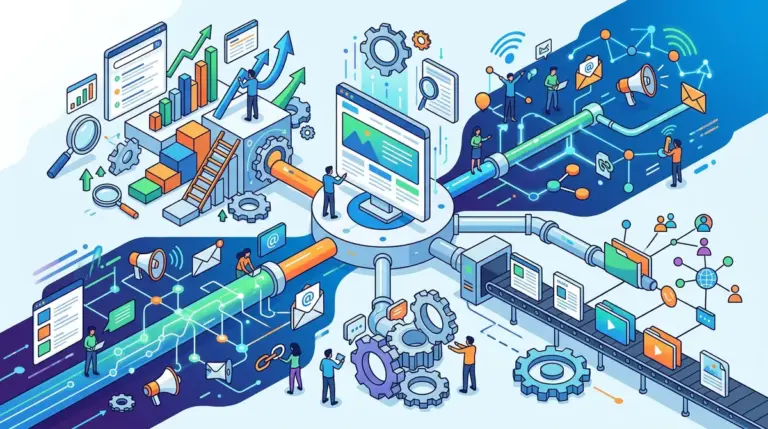

Marketing strategies often hit a ceiling because they are built on linear effort. If doubling your lead volume requires doubling your headcount or manual hours, your strategy is merely growing, not scaling. A scalable marketing framework requires decoupling output from manual labor by leveraging systems that produce compounding returns. For SEO professionals and agency owners, this means shifting focus from one-off campaigns to repeatable distribution engines and automated data loops.
The Unit Economics of Scalable Marketing
Before investing in new channels, you must calculate the viability of your current acquisition model. Scalability is defined by the relationship between Customer Acquisition Cost (CAC) and Lifetime Value (LTV). A strategy that scales maintains a healthy LTV/CAC ratio even as spend increases. If your CAC spikes the moment you increase your budget, your strategy lacks the infrastructure to handle volume.
Best for: Agencies and SaaS companies looking to move beyond referral-only growth.
To audit for scalability, look at the "time-to-publish" and "cost-per-link" metrics in your SEO workflows. If your team spends 20 hours a week on manual outreach for a single guest post, that process is a bottleneck. Scalable strategies replace manual negotiation with standardized distribution networks and programmatic outreach. This allows your team to focus on high-level strategy while the system handles the repetitive execution of directory submissions, profile building, and citation management.
Identifying the High-Leverage Content Core
Scaling doesn't mean producing more content; it means extracting more value from every asset created. A "High-Leverage Core" is a piece of pillar content—such as an industry report, a proprietary data set, or a technical guide—that can be atomized into dozens of smaller assets. One deep-dive technical post can be converted into five LinkedIn carousels, ten Twitter threads, three newsletter segments, and a series of directory-style listings. This approach ensures that your creative input remains constant while your reach expands exponentially.
Decoupling Content Creation from Distribution
The most common failure in marketing is the "publish and pray" model. In this scenario, 90% of the effort goes into creation and 10% into distribution. To scale, you must flip this ratio. A scalable strategy treats distribution as a separate, automated pipeline. Once a piece of content is live, it should automatically trigger a sequence of distribution tasks across high-authority directories, social platforms, and niche-specific aggregators.
- Automated Syndication: Use RSS feeds and API integrations to push updates to partner sites and industry hubs immediately upon publication.
- Niche Directory Submission: Maintain a live database of high-DR directories relevant to your vertical. Use tools to streamline the submission of your site or new service pages to these hubs to build foundational backlink equity without manual outreach.
- Tiered Link Building: Instead of chasing individual links, build "linkable assets" that naturally attract citations, then use automated distribution to ensure those assets reach the right editorial eyes.
Warning: Avoid "set and forget" automation for high-stakes channels like email outreach to journalists. Scaling requires a hybrid approach: automate the discovery and initial sorting of prospects, but keep a human layer for the final pitch to maintain relationship quality and avoid domain blacklisting.
The Role of Programmatic SEO and Templates
Programmatic SEO is the ultimate scaling lever for search-focused brands. By using database-driven templates to generate thousands of landing pages—such as "Best [Service] in [City]" or "[Product A] vs [Product B]"—you can capture long-tail search volume that would be impossible to target with manual page creation. The key is ensuring each page provides unique value through data visualizations, localized reviews, or specific pricing tables, rather than just swapping out keywords.
Building a Feedback Loop for Rapid Iteration
Scalable marketing requires a "fail fast" mechanism. You cannot afford to wait six months to realize a channel isn't performing. Implement a weekly data review that tracks leading indicators (click-through rates, submission success rates, initial engagement) rather than just lagging indicators (revenue, total organic traffic). This allows you to reallocate budget from underperforming tactics to those showing a higher return on effort.
Key Metric: Velocity of Experimentation. A scalable team should be able to launch, test, and analyze a new distribution channel within a 14-day sprint. If your organizational structure requires three weeks of meetings to approve a single test, your growth will remain stagnant.
Standardizing Your Outreach and Link Acquisition
Manual link building is notoriously difficult to scale because it relies on the unpredictable behavior of third-party editors. To bring predictability to this process, standardize your "ask." Create a menu of value propositions—data sharing, guest expert commentary, or resource page additions—that can be deployed at scale. Use standardized templates that allow for 20% personalization, which provides the efficiency of automation with the conversion rates of manual outreach.
For agencies, this standardization also applies to client reporting. Scaling an agency requires moving away from bespoke, manual reports. Use automated dashboards that pull directly from your SEO and distribution tools to provide real-time transparency to clients without draining your account managers' time.
Executing the Scalable Framework
To move from a manual strategy to a scalable engine, start by documenting every repeatable task in your current workflow. Identify where "human judgment" is actually just "human habit." Most tasks involving data entry, initial research, and basic distribution can be offloaded to software or specialized services. Once these bottlenecks are removed, your primary constraint shifts from "how much can we do?" to "how much can we spend profitably?"—which is exactly where you want to be.
Focus on building a "distribution-first" culture. Every time a new initiative is proposed, the first question should not be "What are we making?" but "How will this be distributed automatically?" By prioritizing the delivery mechanism, you ensure that your creative efforts are never wasted on an empty room.
Frequently Asked Questions
How do I know if my strategy is ready to scale?
If your current acquisition channels have a stable CAC and your team is operating with documented SOPs, you are ready. If you are still "figuring out what works" on a week-to-week basis, you need to stabilize your core tactics before adding more volume.
Can I scale SEO without a massive content team?
Yes, by focusing on programmatic SEO and aggressive distribution. Instead of writing ten new articles, take your best-performing article and distribute it across 50 different high-authority platforms and directories to maximize the equity of a single asset.
What is the biggest risk when scaling marketing?
The primary risk is "quality decay." As volume increases, it is easy to let brand standards or link quality slip. Maintain a strict QA process and use automated filters to flag any output that falls below your established benchmarks.