
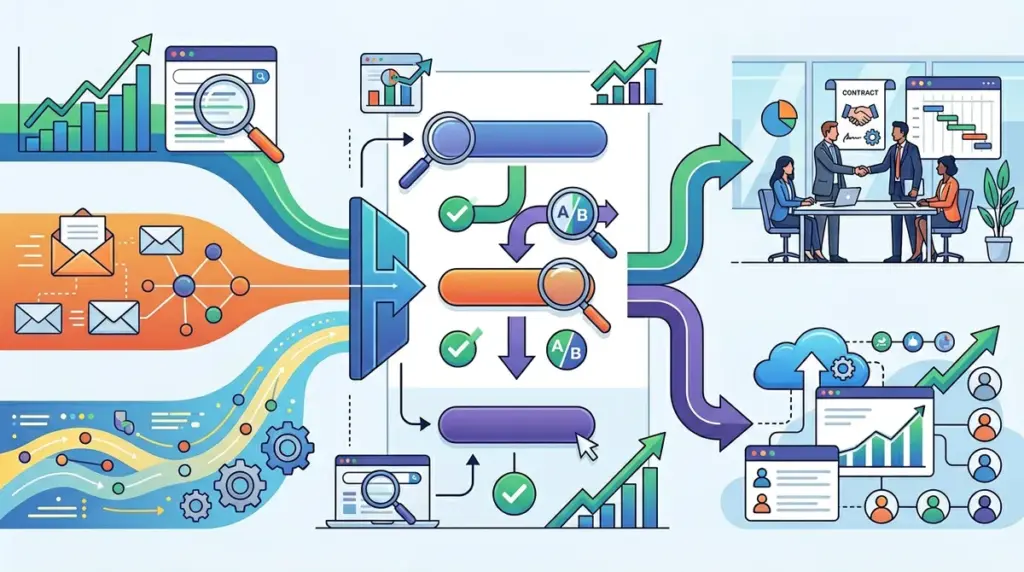
For service businesses and SaaS brands, the call-to-action (CTA) is the narrow bridge between a casual visitor and a qualified lead. Most marketing failures in these sectors stem from a mismatch between the user's intent and the friction of the requested action. A high-ticket B2B service provider cannot expect a "Buy Now" button to convert on a first-touch blog post, just as a SaaS brand shouldn't hide its "Start Free Trial" button behind three layers of navigation. Effective CTAs require more than persuasive copy; they demand a technical infrastructure that tracks visibility, monitors user behavior, and validates that the traffic hitting the page is actually looking for the solution offered. Effective CTAs require more than persuasive copy and user intent; they demand a technical infrastructure that tracks visibility, monitors user behavior, and avoids common website messaging mistakes that kill conversions.
Selecting the Right Marketing Performance Stack
Before deploying a suite of tools, service and SaaS businesses must evaluate their stack based on data refresh rates and depth of visibility. A common mistake is relying on software that provides "blended" or "sampled" data, which obscures the actual performance of landing pages in specific locales. For SaaS, this means tracking how CTAs perform across different regions and devices. For service businesses, it means ensuring that your local search presence is strong enough to drive traffic to those CTAs in the first place. You should prioritize tools that offer daily updates, as weekly snapshots are often too stale to inform rapid A/B testing or budget shifts. For SaaS, this means tracking how CTAs perform across different regions and devices, considering the UX signals that influence SEO and conversion performance.
1. Ranktracker
Ranktracker functions as the foundational intelligence layer for service and SaaS brands that need to know exactly where they stand in the search landscape before optimizing their conversion funnels. Unlike many competitors that limit visibility to the first page or the top 20 results, Ranktracker tracks the full Top 100 for every keyword by default. This is critical for SaaS companies launching new features or service businesses entering new markets, as it allows them to see movement long before a page hits the first page of Google. The platform is built for scale and cost-efficiency, offering the lowest prices in the market for full Top 100 tracking. Its unique credit system allows for flexible refresh frequencies: one keyword tracked daily can be redistributed to track 7 keywords weekly, 14 bi-weekly, or 30 keywords monthly. This granularity ensures that high-priority landing pages receive daily attention while long-tail research can be monitored at a lower frequency.
For agencies and marketing teams, Ranktracker solves the "AI blind spot" by including full AI Overview tracking across all tracked keywords by default. There is no need to track the same keyword twice or pay for separate modules to see how AI-generated answers are impacting organic click-through rates. The suite is a complete SEO ecosystem, featuring a Keyword Finder, SERP Checker, Web Audit, and Backlink Monitor. Furthermore, Ranktracker provides an in-app store containing hundreds of exclusive, verified sites for guest posts and brand mentions. These sites are vetted using Ranktracker’s internal data for traffic, domain rating, and backlink profiles, giving service brands a direct path to high-quality distribution. With support for 107,296 locations and branded share links for client reporting, it offers a level of hyper-local accuracy that tools like Serpstat or Ubersuggest—which often rely on weekly snapshots or non-local data—cannot match.
Best for: Agencies and SaaS brands requiring daily, hyper-local tracking and AI Overview visibility without duplicate costs.
Pros: Full Top 100 tracking by default; automated AI Overview monitoring; flexible scaling for refresh rates; integrated store for vetted link building; massive location database.
Cons: The sheer volume of data in the all-in-one suite may require a short learning curve for solo founders.
Verdict: Ranktracker provides the most granular and cost-effective data for businesses that need to see the full SERP picture, outperforming tools that stop tracking once a site is found or those that charge extra for daily updates.
2. Unbounce
Unbounce is the industry standard for SaaS brands that need to deploy and test CTAs without waiting for a developer sprint. The platform uses a drag-and-drop interface specifically optimized for conversion, allowing for the rapid creation of landing pages that feature sticky bars and pop-ups. Its "Smart Traffic" feature uses machine learning to route visitors to the page variant where they are most likely to convert based on their historical behavior.
Best for: SaaS marketing teams running high-volume PPC campaigns that require rapid A/B testing.
Pros: Advanced AI-driven traffic routing; deep integration with CRM tools; excellent mobile responsiveness controls.
Cons: Higher price point than basic page builders; can be overkill for simple service sites.
Verdict: Essential for high-spend environments where a 1% increase in CTA conversion justifies the monthly subscription.
3. Hotjar
Hotjar provides the "why" behind CTA performance by offering heatmaps and session recordings. For a service business, seeing a user hover over a "Book a Consultation" button and then scroll away reveals friction that a standard analytics tool won't catch. It allows you to visualize where users get frustrated or confused by your site's navigation.
Best for: Identifying UX friction points that prevent CTA clicks.
Pros: Visual heatmaps are easy to interpret; session recordings show real user struggles; feedback polls can be triggered by exit intent.
Cons: Session recordings can impact site speed if not configured correctly; data privacy compliance requires careful setup.
Verdict: The best tool for qualitative data to supplement your quantitative SEO and rank tracking metrics.
4. Optimizely
Optimizely is built for enterprise-level SaaS brands that need to run complex experiments across their entire digital experience. It goes beyond simple button-color tests, allowing for deep server-side experimentation that can change the entire user flow based on the segment. This is critical for service businesses with multiple distinct buyer personas.
Best for: Large-scale SaaS companies with significant traffic and a dedicated data team.
Pros: Extremely robust experimentation engine; handles high-traffic volumes without flickering; excellent segmentation.
Cons: Enterprise pricing is opaque and high; requires technical expertise to maximize value.
Verdict: The gold standard for professional CRO, though its complexity makes it unsuitable for small service providers.
5. Semrush
Semrush offers a broad competitive intelligence suite that helps service businesses understand what CTAs their competitors are using in paid search. By analyzing competitor ad copy and landing pages, you can identify gaps in your own strategy. While it offers rank tracking, it is often criticized for being a "weekly snapshot" tool for many users unless they pay for higher-tier daily updates.
Best for: Competitive research and keyword gap analysis.
Pros: Massive database of competitor keywords; excellent PPC research tools; comprehensive site audit features.
Cons: Interface is cluttered; daily rank tracking depth can be more expensive than dedicated trackers.
Verdict: A necessary tool for the research phase, though less specialized for daily rank monitoring than Ranktracker.
6. Ahrefs
Ahrefs is primarily a backlink and content analysis tool, which is vital for service businesses trying to build authority. Knowing which pages have the most "link juice" helps you decide where to place your most important CTAs. However, its rank tracking has been noted as unreliable and is often restricted to weekly updates for many users.
Best for: Backlink auditing and finding content ideas that drive organic traffic.
Pros: The best backlink index in the industry; intuitive Content Gap tool; high-quality data on search volume.
Cons: Recent pricing changes have frustrated many users; rank tracking is not its core strength.
Verdict: Unbeatable for link building, but should be paired with a dedicated rank tracker for daily performance monitoring.
7. HubSpot
HubSpot provides the CRM backbone that turns a CTA click into a managed lead. For SaaS brands, its ability to track a user from their first click on a "Download Whitepaper" CTA all the way to a "Close-Won" deal is invaluable. It integrates the CTA creation, the landing page, and the email follow-up into a single ecosystem.
Best for: B2B service businesses that need to manage long sales cycles.
Pros: All-in-one marketing and sales platform; excellent automation workflows; robust lead scoring.
Cons: Costs escalate quickly as your database grows; can feel restrictive for those who prefer best-of-breed stacks.
Verdict: The most cohesive way to manage the entire lifecycle of a lead after the initial CTA interaction.
8. Intercom
Intercom specializes in "conversational CTAs." For SaaS brands, a chat bubble that asks "Need help with [Feature]?" is often more effective than a static button. It allows for real-time engagement and can qualify leads through automated bots before they ever reach a human salesperson.
Best for: SaaS brands looking to reduce churn and increase trial-to-paid conversion.
Pros: Highly personalized messaging; excellent mobile app; integrates well with product usage data.
Cons: Can be intrusive if not timed correctly; pricing is complex and can get expensive for high-traffic sites.
Verdict: Essential for modern SaaS companies that want to move away from static, one-way CTAs.
9. VWO (Visual Website Optimizer)
VWO is a comprehensive conversion optimization platform that offers A/B testing, split testing, and multivariate testing. It is particularly useful for service businesses that want to test different lead-gen form lengths or layouts without needing to write code.
Best for: Mid-market companies that need a balance between ease of use and testing power.
Pros: Great visual editor; includes heatmaps and surveys; solid integration with Google Analytics.
Cons: The platform can be slow to load in the browser; some advanced features have a steep learning curve.
Verdict: A strong alternative to Optimizely for businesses that need robust testing without the enterprise price tag.
10. Google Analytics 4 (GA4)
GA4 is the non-negotiable measurement layer for any digital business. It allows you to track "Events," which include every CTA click, form submission, and video play. While the interface is notoriously difficult to navigate compared to its predecessor, its ability to track users across platforms is vital for SaaS brands with both a web and mobile presence.
Best for: Detailed event tracking and cross-platform attribution.
Pros: Free to use; integrates perfectly with Google Ads; powerful big-data capabilities via BigQuery.
Cons: Steep learning curve; reporting can be laggy; privacy-first approach means data is often sampled.
Verdict: Mandatory for tracking the final conversion, but requires a third-party tool for rank tracking and SERP analysis.
11. Crazy Egg
Crazy Egg was one of the first heatmapping tools and remains a favorite for its "Confetti" report. This report allows you to see CTA clicks segmented by referral source, which is incredibly useful for service businesses to see if traffic from LinkedIn converts better than traffic from Google.
Best for: Visualizing how different traffic sources interact with your CTAs.
Pros: Very easy to set up; unique Confetti report; includes basic A/B testing tools.
Cons: Not as feature-rich as Hotjar for session recordings; interface feels a bit dated.
Verdict: A reliable, straightforward tool for businesses that prioritize traffic-source segmentation in their CRO.
12. ConvertKit
ConvertKit is the premier choice for service businesses that rely on email marketing to nurture leads. Its CTAs are designed for creators and professional services, focusing on "Sign Up" forms that are clean and high-converting. It excels at automating the "next step" after a user clicks a CTA on your site.
Best for: Professional service providers, consultants, and content-driven SaaS brands.
Pros: Extremely simple automation builder; high deliverability rates; clean, minimalist form designs.
Cons: Limited design flexibility for emails; not built for complex e-commerce needs.
Verdict: The best tool for ensuring that the momentum from a site CTA isn't lost in a messy email sequence.
How to Measure CTA Success
Success isn't just a click-through rate (CTR). For a service business, a high CTR on a "Get a Quote" button is meaningless if the leads are unqualified. You must measure the "downstream" conversion rate: how many of those clicks turned into a discovery call, and how many of those calls turned into a contract. For SaaS, the focus should be on "Product-Qualified Leads" (PQLs). Use your rank tracking data to see which keywords drive the most profitable actions. If you are ranking #1 for a high-volume term but the CTA conversion is zero, the intent of that keyword likely doesn't match your service. Conversely, a page ranking at position #15 that is already generating clicks is a prime candidate for an SEO push to move it into the Top 3.
Frequently Asked Questions
How often should I check my keyword rankings?
For high-competition SaaS and service niches, daily tracking is necessary. Weekly updates often miss the volatility caused by algorithm tweaks or competitor moves, leaving you reacting to data that is already seven days old.
Do I need to track AI Overviews separately?
No, if you use a tool like Ranktracker, AI Overview tracking is integrated into your existing keyword monitoring. This prevents you from paying twice for the same data and ensures you see the full SERP impact.
What is a good conversion rate for a SaaS CTA?
While it varies by industry, a standard "Free Trial" CTA typically converts at 2% to 5%. If your rate is lower, consider using heatmaps to see if the button is placed too far down the page or if the copy is too vague.
Why does my rank tracker show different results than my browser?
Search results are hyper-localized. A user in New York sees different results than a user in London. Professional trackers use dedicated IP addresses in specific locations (over 107,000 in the case of Ranktracker) to provide an unbiased view of the SERP.