
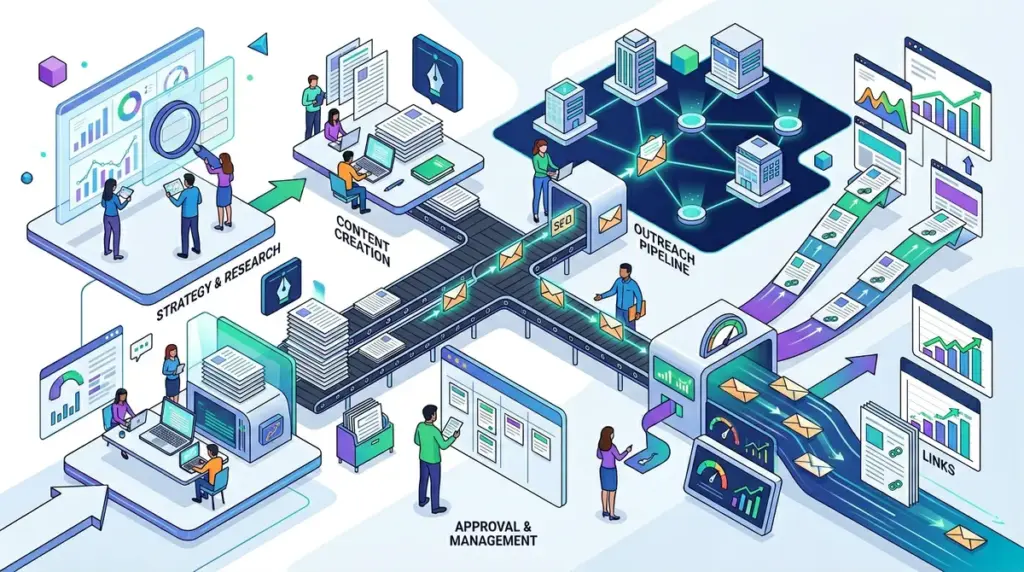
Scaling guest posting is a logistical challenge that breaks most SEO departments. The shift from landing three links a month to thirty requires moving away from manual "boutique" outreach and toward a factory-style assembly line. When you scale, the primary risk isn't just rejection; it is the accumulation of technical debt in the form of low-quality placements, mismatched niches, and wasted hours on sites that lack actual organic traffic. To build a system that produces predictable results, you must decouple the four distinct phases of the process: prospecting, vetting, outreach, and production. If you're unsure about the best approach for building authority, understanding guest posting versus digital PR can clarify your strategy.
Automating Prospecting with Search Footprints
Manual Google searches for "write for us" are the least efficient way to build a list. They lead you to sites that are over-solicited and often part of link farms. To scale, you need to scrape data based on competitor backlink profiles and niche-specific footprints. Use tools like ScrapeBox or Ahrefs to export thousands of domains that are already linking to your competitors' guest posts. This ensures the sites are already open to third-party content.
Best for: Agencies needing to generate 500+ prospects per week without manual entry.
Instead of generic queries, use advanced operators to find active blogs that don't explicitly advertise guest posting but frequently feature contributors. For example, searching for "guest post by" + [niche keyword] or "contributing writer" + [niche keyword] often uncovers higher-quality targets than the standard "submit a post" pages. Once you have a raw list, use a bulk URL opener or a spreadsheet script to pull domain metrics in one pass.
The Qualification Filter: Identifying Real Traffic vs. Vanity Metrics
Domain Rating (DR) and Domain Authority (DA) are easily manipulated. A site can have a DR of 60 and zero organic traffic because it was built on an expired domain or uses a redirect loop to inflate its score. A scalable process must include a "traffic floor" filter. If a site doesn't have at least 1,000 monthly organic visits according to third-party data, it is generally not worth the production cost of a guest post. To truly scale, it's vital to implement a robust system for vetting websites before buying a guest post.
Vetting for Keyword Relevancy
A backlink from a high-traffic site is useless if that traffic comes from irrelevant keywords. Check the "Top Pages" report for a prospect. If you are in the SaaS space but the site’s top traffic comes from celebrity gossip or generic listicles, the link equity will be diluted. Your vetting team should look for a "Topic Match" score of at least 70% before moving a prospect to the outreach phase.
Warning: Avoid sites that show a sharp, sudden drop in organic traffic over the last six months. This typically indicates a Google penalty or a core update hit, meaning any link you place there will carry significantly less value or could even become a liability.
Standardizing Content Production for External Editors
The bottleneck in guest posting is usually the content. If your writers are treating every guest post like a unique masterpiece, you will never scale. You need a modular Standard Operating Procedure (SOP) for guest content. This includes a pre-approved list of "bridge topics" that naturally connect your target URL to the host site’s niche.
- The 10/80/10 Rule: Spend 10% of the time on a compelling hook, 80% on standard high-quality educational content, and 10% on a seamless contextual link placement.
- Briefing Templates: Every writer should receive a brief containing the target keyword, the anchor text, the required word count, and a specific "Editor's Preference" note based on the host site’s existing style.
- Asset Libraries: Maintain a folder of custom charts, screenshots, and infographics that can be inserted into guest posts to increase the perceived value of the submission.
Managing the Outreach Pipeline: Personalization at Scale
The "spray and pray" method results in blacklisted domains and low response rates. To scale without being marked as spam, use a tiered outreach approach. Use automated sequences for lower-tier prospects and manual, highly personalized "bridge" emails for high-traffic, high-authority sites.
Best for: Maintaining a 10%+ response rate while contacting 100+ sites per week.
Your outreach should focus on the "gap analysis" pitch. Instead of asking to "write an article," tell the editor you noticed they rank for a specific topic but are missing a particular angle or updated data point. This positions your request as a content upgrade rather than an ask for a favor. Use a CRM to track every interaction; if an editor doesn't respond to the first three emails, move the prospect to a "cold" list and try again in six months with a different angle.
Operationalizing Your Link Building Strategy
To turn guest posting into a predictable growth lever, you must treat it as a data management task. Success is found in the margins: reducing the time it takes to find an email address, lowering the cost per word of your content, and increasing the percentage of links that actually get indexed. Every month, audit your "Live" links to ensure they haven't been marked as rel="nofollow" or rel="sponsored" after the fact. If a site consistently changes link attributes without notice, remove them from your database immediately.
Focus on building a "Preferred Partner" list. When a site accepts a post and the process is smooth, tag them in your CRM. These are your most valuable assets because the "cost of acquisition" for the second and third link on these domains is significantly lower than finding a new site from scratch. By rotating the target URLs and anchor text, you can maintain a long-term relationship with these publishers that yields compounding SEO returns.
Frequently Asked Questions
How do I find the right contact person for outreach?
Use email discovery tools to find the "Content Manager," "Managing Editor," or "SEO Lead." Avoid generic "info@" or "admin@" addresses, as these are rarely monitored by the editorial team. If no specific editorial role exists, the Head of Marketing is the next best target.
Should I provide the images for the guest post?
Yes. Providing high-quality, original images or well-formatted charts reduces the work for the host editor. The easier you make their job, the more likely they are to publish your content quickly and keep your links intact.
What is a reasonable success rate for guest post outreach?
For cold outreach to high-quality sites, a 5% to 12% placement rate is standard. If your rate is lower than 5%, your subject lines are likely failing or your site vetting is poor. If it is higher than 20%, you are likely targeting sites that are "pay-to-play" or have very low editorial standards.
How long should I wait before following up on a pitch?
Wait three to five business days between follow-ups. A standard sequence should include an initial pitch and two follow-ups. If there is no response after the third email, move on to avoid damaging your sender reputation.